
Rutgers Democracy Lab Catalyzes Month-Long Effort to Solve Grand Challenges

Last month, Rutgers Democracy Lab (RDL) celebrated Solving Grand Challenges Month, a university-wide initiative that mobilized the resources and talents of the Rutgers community to address some of the most complex issues facing our world. With an understanding that interdisciplinary collaboration is vital for public problem-solving, the events tapped into the rich academic landscape that Rutgers has to offer to explore fundamental democratic questions.
Events held by a diverse range of schools, departments, and programs across all of Rutgers’ campuses tackled issues salient to our shared civic life, ranging from understanding the lives of justice-impacted families to combatting AI-driven misinformation and disinformation using creative and innovative formats.
Rutgers Democracy Lab provided seed funding to unleash the talents and creativity of the Rutgers community—leading to a variety of civic opportunities that offered students the chance to explore issues, share stories, and learn from peers and outside experts. The Solving Grand Challenges Month series catalyzed democratic engagement through programming focused on multilingual art and writing, applied improvisation, and participatory sustainability models. Other examples include:
Upstream Democracy: Beauty, Belonging, and Civic Repair — April 9, 2026
On April 9, the Rutgers–New Brunswick Mason Gross School of the Arts hosted Upstream Democracy: Beauty, Belonging, and Civic Repair in partnership with RDL at the university’s Zimmerli Art Museum. Upstream Democracy and the salon’s companion events — including an April 4 “Is America Possible” conversation at Riverside Church, an April 9 Well-Being Concert at Zimmerli, and an April 11 Breathing: A Well-Being Concert at the Guggenheim Museum in NYC — engaged over 350 Rutgers and local community members. The events kicked off the launch of the school’s Arts Health Salon Series, an initiative that integrates academic insights with aesthetic experiences and community voices to humanize complex democratic problems.

For Ian Koebner Pfeiffer, the architect behind the series and the recently named Endowed Chair and Associate Professor in Arts in Health, the event addressed the interrelated democratic crisis of the erosion of civic belonging and the fraying of social cohesion. He noted the salon “brought together brilliant voices from inside and outside the Rutgers community to examine…the relationship between aesthetic experience, civic belonging, and the conditions that make democratic life possible.”
Pfeiffer was particularly heartened by what he described as a “shared commitment to civic imagination” across RDL, Mason Gross, and Zimmerli. This sentiment was amplified by event attendees, reflecting a dedication to the idea that civic repair requires developing and nourishing spaces for cross-cultural, interdisciplinary dialogue. Such spaces serve to activate citizens’ civic capacities and position them as participants in a greater democratic discourse. "Upstream Democracy was the beginning of a conversation, not the end of one,” Pfeiffer reflected.
Reimagining Democracy: Justice Reentry & Community Voice Through Film: Newark — April 15, 2026
On April 15, the Center for Nonprofit Leadership and Development and Office of Community Engagement of the Rutgers–Newark School of Public Affairs and Administration (SPAA), in partnership with RDL and with support from the Rutgers–Newark Cultural Programming Grant, hosted Reimagining Democracy: Justice Reentry & Community Voice Through Film. The event welcomed over 50 attendees from the Rutgers community and general public. The program’s centerpiece was a film screening of A Woman on the Outside, followed by a moderated panel discussion, student-led breakout dialogues, and a community networking reception.
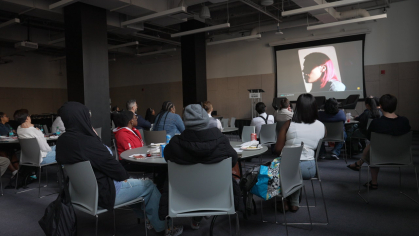
The film presents a personal portrait of Philadelphia native Kristal Bush’s interaction with the carceral system as a witness to the structural barriers and emotional residuals that individuals, families, and communities are forced to reckon with. It left viewers with a sense of the promises and limitations of community-rooted support systems, as it documents the development and dissolution of Bridging the Gap, Bush’s nonprofit van service to connect Pennsylvania prisoners with their families.
The post-screening panel featured film producer Kiara C. Jones and Chris Agans, Executive Director of the New Jersey Scholarship and Transformative Education in Prisons (NJ-STEP) program out of Rutgers–Newark, and was moderated by event organizer and Rutgers–Newark SPAA Associate Professor Lindsey McDougle. Jones, Agans, and McDougle discussed the ethics of documentary practices on sensitive topics, institutional support, system gaps for individuals during and after incarceration, and the role of storytelling in higher education.
For Dr. McDougle, pairing the creative medium of documentary film to prompt initial reflection with academic discussion to distill field-wide insights laid fertile ground for an “intellectually rich and personally resonant” experience for participants.
When reflecting on her motivation for organizing the event, McDougle said that her goal “was to create a space where stories that are often marginalized are centered and taken seriously—not just as narratives, but as forms of knowledge.” Her vision speaks to RDL’s inaugural theme of Inspiring Democratic Engagement by creating space for diverse stakeholders and listening to the voices of those affected by entrenched societal challenges. For her, the program also fostered meaningful connections “between campus and community” while linking “research and lived experience.” She saw a diverse “cross-section” of the Rutgers and local communities represented among the attendees, which ultimately furnished an “intentional and energizing” atmosphere.
“This event reminded us that storytelling is a powerful form of civic engagement, one that can challenge assumptions, build empathy, and inspire action.”
Rethinking Democracy: AI, Power, and Politics — April 17, 2026
On April 17, the Department of Political Science at Rutgers–New Brunswick hosted Rethinking Democracy: AI, Power, and Politics in partnership with RDL. The event featured a brief presentation by event organizer and Assistant Teaching Professor in Comparative Politics Selin Bengi Gümrükçü, followed by interactive breakout sessions where students’ discussions revolved around the following thematic areas:
Democratic futures and digital citizenship, written by Ryan Berg ‘28, explored ways that emerging AI technologies strengthen and undermine democratic institutions.
AI-driven political persuasion and communication, developed by Christian Concepcion ‘28, charted how AI has personalized digital consumption, allowing for microtargeting and automated content generation.
Algorithmic governance and public decision-making, developed by Haozhi Wang ‘27, examined the use of Al and data-driven systems in public decision-making.
Deepfakes, misinformation, and democratic trust, developed by Neel Naladala ‘28, analyzed the exponential growth of AI-generated misinformation content across digital media ecosystems.

Students emerged from the program with a breadth of perspectives on regulatory pathways for addressing the democratic challenges inherent to AI innovation, particularly as its deployment in the public sector grows. "It opened my eyes to the wide range of nuanced perspectives on AI, especially when it comes to its impact on politics, human autonomy, and society as a whole,” shared Neel Naladala at the program’s conclusion.
Bridging Disciplines to Strengthen Democracy
The selected programs are emblematic of how various Rutgers departments combined academic insights with real-world practice, while centering civic dialogue and lived experiences with democratic life. The notion that interdisciplinary collaboration is integral to civic repair lies at the heart of Solving Grand Challenges Month, and is one that can only be realized when stakeholders from across the spectrum are part of the conversation.
A full list of Solving Grand Challenges Month events can be found at this link.
Explore more of RDL's work


