
Constructive Dialogue
Mission
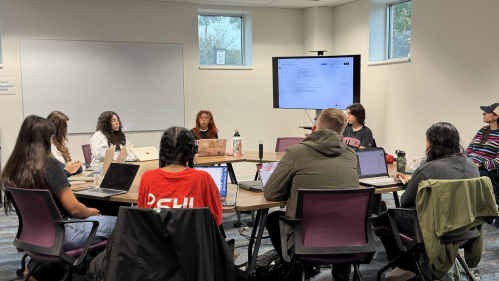
Talking Across Difference is a university-wide initiative meant to equip educators, staff, and students to have productive conversations about difficult and sometimes divisive issues.
A system of self-government requires us to have productive conversations about difficult and sometimes divisive issues. Indeed, our ability to talk across difference is a fundamental democratic skill that can and should be taught to students of all disciplines. Our collective capacity to talk across difference must be supported, however, with university-wide opportunities to learn and practice constructive dialogue.
Talking Across Difference is a university-wide initiative that equips educators, staff, and students to have productive conversations about difficult and sometimes divisive issues. We do this by offering support and opportunities to learn and apply the theory and the practice of respectful dialogue.
This microsite is a dynamic hub for sharing resources and live opportunities for learning and practicing this critical democratic skill.
This initiative is based at Rutgers Democracy Lab (RDL) and is an extension of RDL's participation in the Institute for Citizens and Scholars‘ the Faculty Institute on Dialogue Across Difference and Civic Discourse in the Classroom.
Featured Resources
-
Reports and Guides
- Academic Leaders Task Force on Campus Free Expression. (2021). Campus free expression: A new roadmap. Bipartisan Policy Center.
- Aviles, A., et al. (2023). Transforming conflict on college campuses. Aspen Institute.
- Cortés, C. (2019). Beyond free speech: Fostering civic engagement at the intersection of diversity and expression. National Center for Free Speech and Civic Engagement, University of California.
- Duong, M., Mehl, C., & Jany, C. (2023). Building bridges in the context of inequality. Constructive Dialogue Institute.
- Drury, S., et al. (2024). Better discourse: A guide for bridging campus divides in challenging times. Campus Connect.
- Masterclass. (2022). How to be a better listener in 7 steps. Yanka Industries, Inc.
- Niehaus, E. (2021). Self-censorship or just being nice: Exploring college students’ moral reasoning around free expression issues in the classroom. National Center for Free Speech and Civic Engagement, University of California.
Texts
- Blair, D. (2021). The power of listening: How to improve relationships by becoming an active listener.
- Boatright, R. G., Shaffer, T. J., Sobieraj, S., & Young, D. G. (Eds.). (2019). A crisis of civility?: Political discourse and its discontents. Routledge/Taylor & Francis.
- Chemerinski, E., & Gillman, H. (2017). Free speech on campus. Yale University Press.
- King, P. (2020). How to listen with intention: The foundation of true connection, communication, and relationships.
- Levendusky, M., & Stecula, D. A. (2021). We need to talk: How cross-party dialogue reduces affective polarization (Elements in Experimental Political Science). Cambridge University Press.
- Murphy, K. (2021). You’re not listening. Celadon Books.
- Shaffer, T. J., & Longo, N. V. (2019). Creating space for democracy: A primer on dialogue and deliberation in higher education. Stylus.
- Shaffer, T. J., Longo, N. V., Manosevitch, I., & Thomas, M. S. (Eds.). (2017). Deliberative pedagogy: Teaching and learning for democratic engagement. Michigan State University Press.
Articles and Journals
- Allen, D. (2016). What is education for? Boston Review.
- Bennion, E. A. (2024, February 8). Civil discourse: Helping students to become conversation partners. Political Science Educator, 27(2).
- Brooks, A. C. (2018, January 21). Empathize with your political foe. The New York Times.
- Eisbruger, C. (2023). A case study in civil discourse. Princeton Alumni Weekly.
- Garcia, L. C., & Ulbig, S. (2023). Building political discourse skills: Students as teachers. Journal of Political Science Education.
- Herrity, J. (2024). 10 ways to improve your listening skills (with examples). Indeed.
- Murphy, K. (2020). Talk less. Listen more. Here’s how. The New York Times.
- Rose, J. (2021). How I liberated my college classroom. The Wall Street Journal.
- Schwartz, L., & Mudaliar, H. (2022). Not so fast on campus self-censorship. Inside Higher Ed.
- Speakeasy, Inc. Are you really listening: Hearing vs. listening. Speakeasy, Inc.
- Terenzini, P. T. (2020). Rethinking effective student learning experiences. Inside Higher Ed.
- Vinnakota, R. (2023). Preamble: Roslyn Clark Artis & Jonathan Holloway. Institute for Citizens & Scholars.
- Wahl, R. (2024). Six ways to encourage political discussion on college campuses. The Conversation.
- White, L. (2022). President speaks: Why free speech and diversity and inclusion go hand-in-hand on campus. Higher Ed Dive.
-
Find audio and visual resources related to Talking Across Difference. This collection includes webinars and videos pertaining to civic engagement, facilitating respect conversations, democracy, and dialogue across difference.
- Bridging the Gap with Tina Grace | Building Blocks of Listening: Silence – In this series, Tina Grace teaches us essential skills for fostering understanding and connection.
- Campus Protests: Then and Now – The University of California’s National Center for Free Speech and Civic Engagement explores the similarities and differences between current student activism and student activism in the 1960s.
- Facilitating Respectful Conversations in the Political Science Classroom – The American Political Science Association gathered faculty from multiple institutes of higher education to host a Webinar on building a comfortable classroom environment to have constructive dialogue and inclusive dialogue on politics.
- How Our Friendship Survives Our Opposing Politics – Join Caitlin Quattromani and Lauren Arledge, two best friends who navigate friendship with different political views. In this TED talk with Caitlin and Lauren (2017) learn how they actively chose to engage in dialogue and skills they utilized to maintain friendship.
- Listening is a Superpower – The ability to listen well, especially to someone you disagree with, is a fundamental skill of bridgebuilding. Bridging the Gap founder Simon Greer offers a step-by-step guide to improving your own listening skillset in this instructional video. The film offers an overview of the power of listening, the science behind effective listening, and practical activities for practicing these skills. This video can be used by educators as a preparation tool before they teach listening in the classroom, or as a curricular tool to use with students either as a pre-watch prior to a class discussion, or as a standalone online session on the skills of listening.
- Re/Designing Democracy – Hosted by AAC&U’s Institute for Democracy and Higher Education (IDHE), this webinar provided an overview of “Democracy Re/Designed,” a conceptual framework and a set of tools for engaging students—and others—in discussions about the future of democracy. Learn how your campus can get involved and how you can use the tools to facilitate these discussions.
- Talking Across Differences: A Healing Justice Framework for Assisting International Students in the U.S. – Join Ting Fang Claire Chen, Carded Souza, and Seojung Lee from Colorado State University to engage in conversation about Talking Across Difference among international students.
- Talk LESS, Listen MORE | Simon Sinek – Making someone feel heard doesn’t mean you’re wrong. To achieve any amount of peace or understanding, we need to be curious and LISTEN instead of demonizing the opposition.
- The Power of Listening | William Ury | TEDxSanDiego – William Ury explains how listening is the essential, and often overlooked, half of communication. His stories of candid conversations with presidents and business leaders provide us with impactful lessons, such as understanding the power of a human mind opening up. He asks us to join a listening revolution, and promises that if we all just listen a little bit more, we can transform any relationship.
- 4 Things All Great Listeners Know – It’s easy to tell when someone’s not paying attention, but it can be surprisingly tricky to know what good listening looks like. Good listening is one of the most important things we can do to improve our relationships, develop our worldview, and potentially change people’s minds. So what can we do to become better listeners? Dig into different strategies that can improve your listening skills.
- 5 Ways to Listen Better | Julian Treasure | TED – In our louder and louder world, says sound expert Julian Treasure, “We are losing our listening.” In this short, fascinating talk, Treasure shares five ways to re-tune your ears for conscious listening — to other people and the world around you.
-
This page offers activities that can be used in the classroom or can be modified to use in other group settings. Please find a descriptions of the organizations and resources below.
- Collaborative Discussion Project – Interactivity Foundation collected a toolkit of activities to teach collaborative discussion skills and mindsets. The toolkit includes 5 modules with activities related to different types of collaboration.
- Duke University Polarization Lab – Offers free online resources to help fight polarization by allowing people to measure the strength of their echo chamber, learn what their tweets say about their political ideology, and follow bots that help find conversation partners with views that differ from their own. This can be very instructive to students as they consider the ways in which their own social media habits are shaping their understanding of—and attitudes toward—people with whom they disagree.
- Inclusive Teaching through Active Learning – Brown University’s Harriet W. Sheridan Center for Teaching and Learning provides activities on Inclusive Teaching Through Active Learning. Learn how to structure active learning to inclusive learning, what you’ll need to reach active learning techniques, and how to use an active approach in online and hybrid classrooms.
- Lesson: Talking Across Differences – Beyond use during digital or in-person orientations, the video adaptation provided by the Foundation for Individual Rights and Expression can be placed on university web pages explaining student rights or diversity and inclusion pages to give a fuller picture of how to embrace difficult conversations.
- Practicing Democracy Toolkit – Campus Connect provides a comprehensive toolkit including practical approaches and strategies to incorporate into the classroom. These strategies develop students’ capacity to engage in talking across difference and public problem-solving.
- The Constructive Dialogue Institute’s Activities & Resources – Within their resource library, the Constructive Dialogue Institute has helpful civil discourse and listening activities such as “Hopes and Concerns”, “Spotlight”, “Structure for Group Dialogue”, “Listening Sessions”, “The Debrief”, “Minute Meetups”, “Co-Creating Resilient Group Norms”, “The Questions Game”, “Spectrum of Beliefs”, and “My Political Values”.
- The Unify Challenge – Unify America presents some helpful materials, including online college bowls that match people from different ideological backgrounds for one-on-one guided conversations online. The easy-to-use online platform provides everything participants need to engage in a one-hour guided activity appropriate for extra-curricular, co-curricular, and curricular use.
- What Does Community Membership Mean? – The University of Michigan offers a variety of civic learning activities on their website, and this particular activity helps students think about what it means to be a member of the community and consider how they want to act as a member of the university community.
- YourLogicalFallacyIs.com – Offers free materials to teach students, or yourself, about logical fallacies and individual biases that clog our thinking and prevent us from logical, evidence-based reasoning and discussions. Understanding our own biases and recognizing common logical fallacies is an important first step to creating the self-awareness and critical thinking skills required to engaged in productive conversations about controversial political issues.
-
Across the country, there are a number of regional and national organizations working to encourage productive dialogue. Learn more about them here (descriptions of organizations taken from their web materials).
- Braver Angels – Leads the nation’s largest cross-partisan, volunteer-led movement to bridge the partisan divide for the good of our democratic republic.
- Citizen University – Builds a culture of powerful, responsible citizenship across the country by designing gatherings, rituals, and workshops for people who are searching for new ways to strengthen civic culture in their hometown.
- College Debates and Discourse Alliance – Teaches students to honor ideological diversity, foster civil discourse on college campuses, and cultivate student and faculty leaders to carry the movement forward.
- Difficult Dialogues National Resource Center – Facilitates transformative change among higher education institutions and its partners to address the persistent challenges to justice, equity, and a healthy environment.
- Engaging Differences, A Program at the National Institute for Civil Discourse – Engages in conversations across the divide, opening doors to finding common ground and moves our country toward a more perfect union.
- Greater Good Science Center, University of California, Berkeley – Studies the psychology, sociology, and neuroscience of well-being and teaches skills that foster a thriving, resilient, and compassionate society.
- Interfaith America – Operates based on the idea that religious difference should serve as a bridge of cooperation rather than a barrier of division.
- Institute for Citizens and Scholars – Ensures that young people gain a deep understanding of our history, culture, government, institutions, and current affairs from diverse sources and perspectives.
- Kettering Foundation – Works to inspire and connect individuals and organizations to advance thriving and inclusive democracies around the globe.
- Living Room Conversations – Connects people across divides – politics, age, gender, race, nationality, and more – through guided conversations proven to build understanding and transform communities.
- National Coalition for Dialogue & Deliberation – Brings people together across divides to discuss, decide, and take action together effectively on today’s toughest issues. Serves as a gathering place, a resource center, a news source, and a facilitative leader for this vital community of practice.
- National Issues Forum – Creates a framework for the deliberative process to ensure a careful, nonpartisan way of presenting alternatives and welcoming different views.
- Project Pericles – Project Pericles is at the forefront of civic engagement and social responsibility in areas including faculty and course development, curricular coherence, and research into best practices.
- Stavros Niarchos Foundation (SNF) Agora Institute – Brings together scholars and practitioners from a variety of disciplines to help strengthen global democracy through improved and expanded civic engagement and informed, inclusive dialogue.
- The American Association of Colleges and Universities – Advances the democratic purposes of higher education by promoting equity, innovation, and excellence in liberal education.
- The Better Arguments Project – A national civic initiative created to help bridge divides – not by papering over those divides but by helping people have Better Arguments. In this sense, arguments don’t have to drive us apart. Better Arguments can bring us together.
- The Constructive Dialogue Institute – Works with institutions across the education, for-profit, non-profit, and public sectors to help them communicate across differences and build inclusive cultures.
- The Human Library Organization: Unjudge Someone – The broad selection of books provides readers with ample choice to challenge their stereotypes and so more than a thousand readers took advantage leaving books, librarians, organisers and readers stunned at the reception and impact of the Human Library.
- The Village Square – A non-partisan public educational forum on matters of local, state and national importance dedicated to maintaining factual accuracy in civic and political debate by growing civil discourse on divisive issues, and recalling the history and principles at the foundation of our democracy.
- Unify America – Creates experiences that reduce political polarization, teach critical civic skills, and give people across the country a chance to make their voices heard. Includes practice grounds like the Unify Challenge College Bowl, which has connected thousands of students across the U.S. for respectful conversations about hot-button issues and shared goals, and civic engagement opportunities, like the Citizens’ Assembly in Montrose, Colorado, that bring communities together to solve their own local challenges cooperatively.
Undergraduate Opportunities
Talking Across Difference program is Rutgers Democracy Lab's core Constructive Dialogue program, with a student leadership opportunities designed to hone their skills in dialogue, facilitation, and navigating challenging conversations while helping build a more connected campus community.
