
Rutgers Democracy Lab Showcases Democracy Summer Research Fellows at Inaugural Symposium

On September 17, Rutgers Democracy Lab (RDL) hosted a university-wide symposium that brought together roughly 100 Rutgers doctoral students, faculty, and staff to engage with research projects related to U.S. democracy.
The Cook Student Center at Rutgers–New Brunswick was abuzz with activity for RDL’s Democracy Summer Research Symposium, an event showcasing 25 research projects from the inaugural cohort of Democracy Summer Research Fellows. The diversity of attendees was matched by the interdisciplinarity of the fellows, who represented 15 academic disciplines across Rutgers–New Brunswick, Rutgers–Newark, and Rutgers–Camden.
Each project received funding to support travel for archival research, hiring undergraduate research assistants, accessing datasets for analysis, and other research activities. Fellows conducted research on a number of themes connected to U.S. democracy, including democratic innovation, deliberative dialogue, and the role of artificial intelligence (AI).
Building a community of scholars studying democracy
Eyal Hanfling, Director of the Technology and Democracy Research Hub at Rutgers Democracy Lab, who spearheaded the fellowship program, kicked off the event with introductory remarks. He described how the program creates a uniquely interdisciplinary community, highlighting projects that explored data centers and political polarization from different disciplines.

Next, Mark Robson, Associate Vice Provost for Graduate Education for Rutgers University–New Brunswick and Dean of the School of Graduate Studies welcomed attendees. Robson spoke on the value of spaces that promote cross-disciplinary pollination, and assigned attendees with a simple task of learning something new and making a new connection.
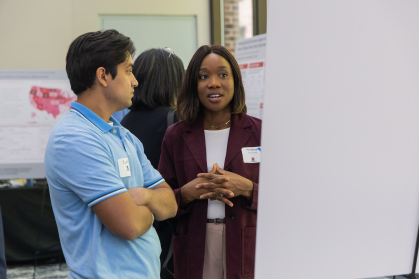
Two dozen research posters adorned the Cook Student Center’s multipurpose room for the event’s signature program that highlighted research on themes ranging from Black politics in New Jersey and public history to worker cooperatives. Multiple projects focused on similar themes, using diverse methodological approaches to explore timely questions:
Data Centers:
- Lina Moe (Urban Planning and Public Policy) uses Vineland, NJ as a case study to explore how communities can govern the construction of data centers.
- George Quinn (Political Science) fielded a survey experiment that finds that utility bill concessions can increase public support for data centers.
- Safiyeh Tayebi (Geography) is analyzing frameworks used to evaluate data centers’ environmental impacts.
Political Polarization:
- Yi Zhao and S.M. Mehedi (School of Communication and Information) explore how AI can be used to generate personalized, persuasive messages to bridge partisan divides.
- Samantha Deane (School of Management and Labor Relations) studies how workplaces can foster dialogue between coworkers with different political identities.
- Sarah Mughal (Psychology) analyzes the effects of different kinds of stereotypes on political polarization and cooperation.
Exploring the challenges of conducting civically-engaged research
After perusing the Fellows’ research posters and forming new connections, the program moved to a panel on civically engaged research, a method in which researchers co-create knowledge that contributes to addressing real-world challenges, often in collaboration with local community partners.
In the spirit of interdisciplinary dialogue, the panel included perspectives from faculty and community partners conducting research across the social sciences, health, and communication. It featured Professor of Public Policy and Administration at Rutgers–Camden Stephen Danley, Professor of Political Science at John Jay College-CUNY Samantha Majic, Associate Professor in Library and Information Science at Rutgers–New Brunswick Charles Senteio, and Founder and Executive Director of Lazos America Unida Teresa Vivar.

Panelists took turns speaking on their experiences, first explaining what civically-engaged research meant to them before exploring strategies attendees could use to develop and sustain partnerships with non-academic stakeholders. Vivar and Senteio reflected on their personal experiences working together and the challenges of forming partnerships. They explained that partnerships require cultivating mutual trust, respect, and “seeing” the community, or acknowledging their role in co-creating research.
“Meet people where they are at—whether that is physically, socially, or otherwise—and center their interests in your project development,” explained Samantha Majic, summarizing the panel’s insights. In other words, civically-engaged research requires sustaining relationships that connect insights to communities, not simply leading one-off research initiatives.
For some in attendance, the panel was an introduction to civically-engaged research, while others had opportunities to compare experiences and build a network of engaged scholars at Rutgers.

The event culminated with workshops for PhD students to discuss topics covered during the panel in more depth. One workshop, led by Senteio and Vivar, focused on strategies and best practices for forming successful research partnerships, while a second led by Danley and Majic focused on navigating hiring, tenure, and the academic publishing process while conducting civically-engaged research. PhD students in attendance, including first year candidates and students on the job market, were able to connect with panelists and reflect on the progress they made over the summer.
For George Quinn, PhD student in Political Science at Rutgers–New Brunswick, the symposium’s interdisciplinary focus was meaningful. “This event really helped connect researchers across disciplines. Many of us study politics, but in different ways. The symposium gave us an opportunity to share research with diverse audiences,” he said. Quinn’s comment illustrates a core objective of Rutgers Democracy Lab’s work: connecting communities across Rutgers for interdisciplinary approaches to studying and improving American democracy.
More information about the Democracy Summer Research Fellowship and descriptions of each of the fellows’ projects is available here.
Explore more of RDL's work


