
Dialogues and the Common Good: a Reflection on RDL's Inaugural Fireside Chat with Senator Jeff Flake (R-AZ)
By Mahima Thoguru
September 27, 2025
Part I: “Dialogues”
On September 23rd, Rutgers Democracy Lab and the Eagleton Institute of Politics hosted their first fireside chat with Jeff Flake. Flake served in the U.S. Senate from 2001 to 2013 and was the US Ambassador to Turkey in the Biden Administration. The event was hosted in partnership with the Richard D. Heffner Open Mind Lecture series, aiming to spur free discourse across different perspectives. As a member of RDL’s inaugural cohort of the “Think and Do Tank,” I had the privilege of attending the fireside chat in person.
My afternoon began with the relentless determination to catch the last shuttle to the New Jersey Bar Association. As I ran along the lush, lime-colored field towards Woodlawn mansion, I harbored a thousand feelings at once. Anticipation, fear, excitement, and doubt all seemed to collide into a singular mass, forming at the pit of my stomach. I did not know much of Flake, apart from the fact that his political stances differed from my own. As a left-leaning student, I feared that he would undermine my values or pit his views against my own. And so, I carried my mass on the shuttle, towards my eventual destination. As I arrived at NJSBA, I was greeted by the smell of coffee amidst stiff handshakes and lively chatter.
Moments later, Flake’s entrance cued attendees’ eager silence, signaling the start of the fireside chat. Quick, measured steps padded around the audience as the camera crew began to film. As the room dimmed, focus shifted towards the front of the room. The first portion of the event, moderated by my fellow RDL classmate, Shayam, consisted of Flake answering attendees' pre-submitted questions. Inquiries were thoughtful and diverse, ranging from his thoughts on current political issues, his experiences as a senator and ambassador. Out of all his responses, however, I found myself to be particularly intrigued by Flake’s work on Immigration Reform. As a Senato
r in the Obama Administration, he was part of a bipartisan (4 D; 4 R) “Gang of Eight,” composing the Border Security, Economic Opportunity, and Immigration Modernization Act of 2013. The bill aimed to ease the transition for undocumented immigrants to become American citizens. This particularly surprised me, as the Republican platform has historically been synonymous with anti-immigrant rhetoric. As a daughter of immigrant parents, I felt validated upon knowing about Flake’s efforts. My mass of fear began to shrink until I no longer felt its grip over my body.

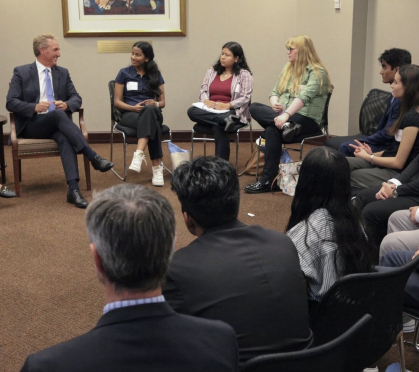
After the moderated discussion, the fireside chat, the atmosphere began to brighten, and the focus had now shifted to us. The chairs, originally arranged in rows, now shifted to a large, Socratic-Seminar style circle. The floor was open for attendees to facilitate dialogue with Flake. The air of formality transformed into something more personal and intimate. A student expressed that he felt discouraged from promoting civic engagement as a non-partisan individual in polarizing political spaces. Upon hearing this, Flake encouraged the attendee to become involved in his community. Additionally, he emphasized that one should not let division deter them from inspiring change in their communities.
Part II: “My Reconciliation”
In the fourth week of Democracy Lab, I was introduced to the idea of the “Common Good.” This concept was defined by ethicist John Rawls as “certain general conditions that are...equally to everyone's advantage.” Catholic religious traditions expanded on this meaning, “the sum of those conditions of social life which allow social groups and their individual members relatively thorough and ready access to their own fulfillment.” Thus, the common good typically takes the form of public institutions that are designed to be free and accessible to constituents, regardless of social class, race, or gender. Typically, these institutions resemble public schools, libraries, or public safety networks, as they serve to provide citizens with free access to security and information resources.
However, while the “Common Good” is typically used to refer to the tangible, my interpretation of this idea extends to underlying motives coupled with a desire to enhance the quality of life. For instance, a resident, upon witnessing food insecurity in their town, may advocate for the establishment of a local food bank. In this scenario, a constituent contributes to the common good through an act of public service. A politician may promote the common good on a larger scale by creating legislation that spurs public service or reforms existing accessible institutions.
Throughout the Fireside chat, Flake’s actions embody the Common Good. His work in the “Gang of Eight” aimed to give an underserved demographic (undocumented immigrants) an accessible pathway to gaining citizenship, while increasing border security. Attaining legal status in the US is difficult and tedious, taking up to several years to process. Furthermore, Flake was aware that many in his party opposed his bill. The Border Security, Economic Opportunity, and Immigration Modernization Act failed to pass in the House of Representatives, as it was opposed by a majority of House Republicans. Despite this outcome, Flake’s divergence from party consensus, coupled with his collaboration with his Democratic colleagues, suggests that he valued implementing the Common Good over expressing party loyalties. While partisan politics can be useful in drawing attention to specific issues, it simultaneously creates echo chambers. When individuals are trapped within information silos, their perceptions of the Common Good become limited, leading to potential for bias and harm. Collaborating with different perspectives allows for an impartial perception of civic change. In doing so, individuals of bipartisan political backgrounds can come together to implement efficient solutions to ongoing civic problems. Flake’s words of encouragement to the nonpartisan student further establish this point; the desire to enhance constituents’ lives is far greater than division along party lines.
As I mention this, however, I also admit that I, too, fall victim to overpartisanship and fear engaging in meaningful dialogue with individuals who disagree with my stance on civic issues. It is this fear that contributed to my anxiety upon arriving at the fireside chat. Upon knowing that Flake is a Republican, my immediate assumption was that he was ignorant or indifferent to the problems I identify with as a South Asian American. However, this was far from the case. Flake’s experience serves as a testament to how common ground and the Common Good can coexist within partisan spaces.
Part III: “Action”
As we move forward, I encourage my readers to replicate the findings of the Common Good in their daily lives. While we may not be politicians or lawmakers, that does not rid us of our ability to initiate small, meaningful acts of change. Whether you choose to collaborate with communities to implement a project or initiate dialogue within our immediate circles, your actions will create an impact, creating a ripple effect for the world to eventually witness.