
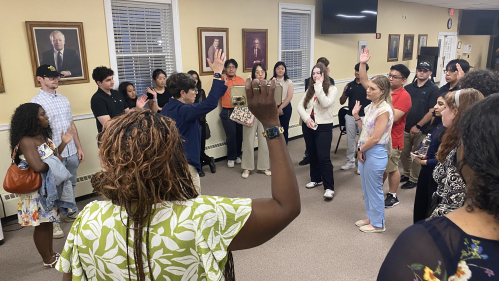
Join the Rutgers Democracy Lab in Solving Grand Challenges
The Rutgers Democracy Lab (RDL) at the Eagleton Institute of Politics is proud to announce the inaugural Solving Grand Challenges Month, taking place across April 2026. This university-wide initiative invites schools, departments, institutes, and centers across Rutgers University to host dynamic programs that explore innovative solutions to pressing democratic challenges.
Solving Grand Challenges Month Events
Throughout the month, you’ll find opportunities across our campuses to engage in hands‑on activities, conversations, and workshops that highlight Rutgers’ commitment to innovation, civic engagement, and public‑minded research. Solving Grand Challenges Month celebrates the creativity and expertise that makes Rutgers a leader in tackling complex societal problems.
-
The New Jersey State Policy Lab at Rutgers University and SPIA in NJ at Princeton University will be hosting the third annual Policy Collaboratory at the Heldrich Center for Workforce Development on March 25th. This collaborative event, sponsored by the Rutgers Democracy Lab, will welcome graduate students to work together and brainstorm various solutions to address access to higher education in the Garden State.
Explore more here
-
Interested in health policy? Want to participate in a one-time advocacy project? Join the American Cancer Society undergraduate organization and Rutgers Medical School psychologist and researcher, Dr. Danielle Llaneza, for a one-time workshop on a health policy and advocacy project! This free, two-part workshop will introduce foundational health policy concepts that connect to real-world clinical problems using examples from active legislation and you will partake hands-on advocacy activity where you will be taught how to connect with NJ Congressional staff and engage in a letter/ email - writing campaign.
Register here
-
Voices of Belonging is a multilingual art and writing workshop exploring language, community, and civic engagement together! In uncertain times, we gather to write, make art, build connection, and safety in community. Voices of Belonging is a multilingual art and writing workshop exploring language, community, and civic engagement. Create poetry, collage, and visual-text work in any language(s), with the opportunity to share at an open mic and pop-up gallery. This event will provide dinner for all attendees and is a drop-in event, so feel free to come when you can!
Register here
-
Join Rutgers New Jersey Medical School and University Hospital for an engaging lunch and learn exploring the connection between civic engagement and health outcomes - and learn how you can help patients and colleagues register to vote.
Explore more here
-
Join us to discuss how diverse fields including STEM, social sciences, humanities, and policy come together to shape solutions that strengthen democratic engagement and work alongside faculty and peers from multiple departments to discuss real challenges facing communities today.
Register here
-
Upstream Democracy: Beauty, Belonging, and Civic Repair is a flagship public salon examining how the arts, culture, and aesthetic experience strengthen the upstream conditions of a healthy democratic society: belonging, civic trust, social connection, and collective well-being. It brings together international, national, state, community, and clinical perspectives on civic health, exploring how cultural strategies—and the psychological dimensions of aesthetic experience—function as civic infrastructure capable of renewing the upstream foundations of democratic life.
Register here
-
Meet the people who are working to deal with the consequences of climate change and urban environmental injustice in Camden. Learn from the experts on what issues are most critical for Camden today. Network with community stakeholders!
Register here
-
Join us for an evening of film, dialogue and community connection. This event will feature a film screening followed by a moderated discussion, student-led breakout dialogues and a community networking reception.
Explore more here
-
Join Rutgers New Jersey Medical School and University Hospital for an engaging lunch and learn exploring the connection between civic engagement and health outcomes - and learn how you can help patients and colleagues register to vote.
Explore more here
-
Join us for an engaging, hands-on experience that brings democracy to life through Applied Improvisation with Dr. Don Waisanen, author of Improv for Democracy! Through play, practice, and reflection, participants will build real-world skills in dialogue, collaboration, and communication across differences.
Register here
-
Join us for an informal discussion, and guided small-group dialogue to explore how AI is transforming political communication, governance, activism, and democratic trust.
Register here
-
Learn about current policy. What would you change? How do we make it better? How can we get it enacted?
Register here
-
An open showcase highlighting the work of the Rutgers Democracy Lab during its inaugural year. You'll hear remarks from RDL's inaugural director, Dr. Nick Longo, followed by fast-paced lightning talks from RDL faculty and staff, as well as a parallel session of student poster presentations featuring hands-on democratic engagement and research in action. Visitors will have the opportunity to meet RDL students and faculty fellows, explore ongoing projects, and engage with RDL staff and partners.
See the full event schedule and registration here.
-
Learn about current policy. What would you change? How do we make it better? How can we get it enacted?
Register here
-
Join us for a one-day workshop that explores the tension between democratic participation and scientific complexity in climate and sustainability governance. Learn from a panel of researchers and practitioners and explore methods to integrate public expert knowledges including participatory scenario planning and environmental competency groups.
Register here
Submit a Program Proposal to be Part of Grand Challenges Month
All events should align with RDL’s theme, Inspiring Democratic Engagement, and foster interdisciplinary collaboration, civic innovation, and actionable outcomes.
To be considered for funding, please read the instructions carefully and submit an application by December 8, 2025. Applications will be considered on a rolling basis. Applicants can expect a decision by December 19, 2025.
-
Who can apply:
Faculty (tenured, non-tenured, and lecturers) and staff from all Rutgers campuses — New Brunswick, Camden, Newark, and Rutgers Health.
Collaborative and cross-campus teams are strongly encouraged.Funding:
Awards up to $5,000 (exceptions considered for demonstrated need)- Indirect costs, salaries, and fringe benefits are not allowable
- Applicants must use the provided budget template and secure their own event venues
- Multiple proposals from the same unit are welcome
- Disclose any additional funding sources in your application. External funding will not affect proposal evaluation
Special consideration will be given to proposals that:
- Involve multiple disciplines or campuses
- Meaningfully engage students and the Rutgers community
- Encourage public participation and partnerships
-
Each proposal should include:
- Title and abstract
- Proposed date, time, and location
- Target audience(s)
- Implementation plan
- Deliverables and anticipated outcomes
- Impact statement
- Outreach or social media plan
- Budget (use budget template)
File naming convention:
LastName-EventTitle-SGC-Proposal
LastName-EventTitle-SGC-Budget
Deadlines:
- Proposal deadline: December 1, 2025
Event materials due: February 1, 2026 (flyers and event details for inclusion on RDL’s website and marketing materials)
Questions?
-
Proposals should align with Inspiring Democratic Engagement and promote civic participation across Rutgers.
Example focus areas include:- Voter education and engagement
- Youth civic leadership
- Participatory policy-making
- Media literacy and combating mis/ disinformation
- Inclusive dialogue and deliberation
Programs may take many forms, such as:
- Deliberative Democracy Dialogues – Cross-partisan conversations bridging ideological divides
- Digital Democracy & Civic Tech Events – Hackathons, app/tool development, ethical tech governance roundtables
- Policy Summits – Reforming democratic institutions like campaign finance or electoral systems
- Arts & Culture for Democracy – Exhibits, performances, or film screenings
- Scenario Planning Workshops – Addressing future civic or governance challenges, such as AI in elections, climate governance
- Civic Simulation Games – Modeling democratic decision-making
-
Approved programs will receive an RDL Media Kit with promotional tools. Participants are encouraged to share:
- Digital or social media content
- Research or other project outputs
- Event stories and highlights
Selected participants may also be featured in RDL storytelling campaigns to highlight their work.
Selected programs will be required to distribute a short RDL survey to participants at the end of their event. Organizers can provide 1-3 event-specific questions (if interested) to include in the RDL survey. -
Proposals will be reviewed based on:
1. Alignment with RDL Theme- Does the proposal clearly reflect the 2026 theme: Inspiring Democratic Engagement?
- Does it address current or emerging democratic challenges?
2. Civic Impact
- Does the program aim to develop solutions to address civic participation, democratic literacy, or public engagement?
- Will it foster meaningful innovation in democratic practice?
3. Interdisciplinary Collaboration
- Does the proposal involve cross-functional or cross-campus collaboration?
- Are diverse academic disciplines or community perspectives represented?
4. Student and Community Engagement
- Does the program actively involve students?
- Will it cultivate partnerships with local organizations or civic groups?
5. Innovation and Creativity
- Is the program concept original, creative, or experimental in its approach to solving democratic challenges?
- Does it introduce new formats, tools, or methods for civic engagement?
6. Feasibility and Planning
- Is the implementation plan clear, realistic, and well-structured?
- Are logistics (venue, timeline, staffing) thoughtfully considered?
7. Deliverables and Outcomes
- Are the expected deliverables (e.g., white papers, prototypes, media content) clearly defined?
- Will the program produce tangible outcomes or insights that can be shared or scaled?
8. Budget and Resource Use
- Is the budget reasonable and aligned with the program’s scope?
- Does it follow RDL’s funding guidelines (e.g., no indirect costs, salaries, or fringe benefits)?
9. Outreach and Visibility
- Does the proposal include a plan for outreach, promotion, and/or media engagement?
- Will it contribute to RDL’s broader visibility and storytelling efforts?
10. Inclusion
- Does the program promote inclusive participation and represent diverse voices?
Compliance Notice:
The Rutgers Democracy Lab supports open, respectful dialogue and diverse perspectives. Funds may not be used to influence elections or political campaigns. Funding does not imply endorsement of viewpoints. Noncompliance may result in revocation of funds and disqualification from future opportunities. -
Submit your proposal by December 8, 2025, and help shape RDL's vision for a stronger, more inclusive democracy.